

We’re pleased to highlight the following recent activities from our colleagues around the globe:
China
1. Evidence-Based Chinese Medicine and Technology Assessment (eCMTA) is a new, open‑access, peer‑reviewed international journal dedicated to publishing high‑quality evidence‑based research that supports healthcare services, with a particular focus on Chinese and integrative medicine. The journal is jointly sponsored by Beijing University of Chinese Medicine and Tsinghua University Press, and its Editors‑in‑Chief are Prof. Jianping Liu and Prof. Nicola Robinson.
The mission of eCMTA is to advance the integration of Chinese medicine into mainstream healthcare by generating robust evidence that informs scientific decision‑making. The journal covers six core areas: methodology and techniques, evidence synthesis, standards and norms, technology assessment, evidence‑based decision‑making, and evidence‑based clinical studies. There are no article processing charges (APCs) until December 31, 2027. Please visit the website to see more information about the journal and submit manuscripts of interest.
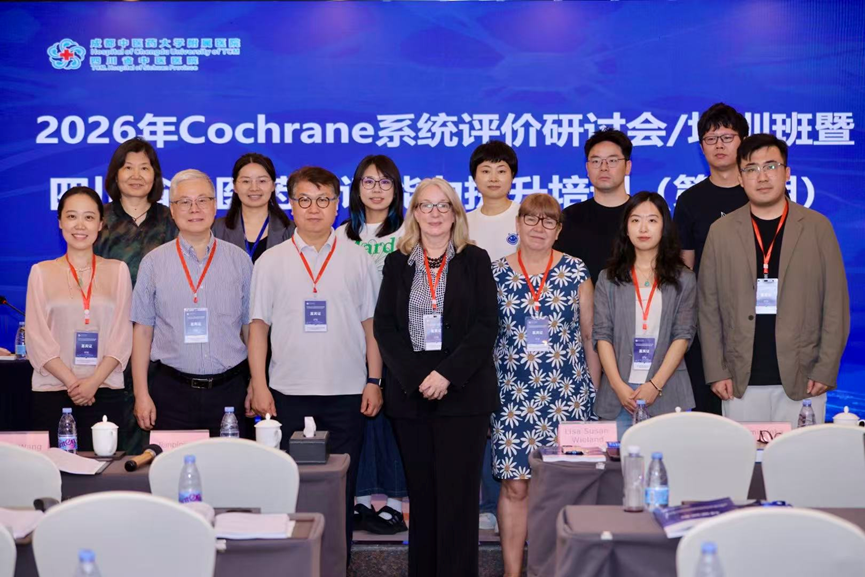
2. A Cochrane systematic review method workshop was held on 22-23 May 2026 in Chengdu, China (photo below). It was sponsored by the Center for Evidence-Based Medicine, Hospital of Chengdu University of Traditional Chinese Medicine. Prof Jianping Liu and his team organized and facilitated this workshop, and foreign guest lecturers included Dr Myeong Soo Lee (Korea Institute of Oriental Medicine and Cochrane Complementary Medicine Korea), Ms. Dimitrinka Nikolova (Managing Editor of Cochrane Hepato-Biliary), and Prof L. Susan Wieland (Director, Cochrane Complementary Medicine). Seventy participants from the university and hospital attended the two-day workshop and the post-workshop survey showed over 95% satisfaction with the contents and learning process.
Brazil
To support evidence-informed decisions, Cochrane Complementary Medicine Brazil is disseminating Portuguese-language Blogshots every two weeks through the website and social media channels of the Brazilian Academic Consortium for Integrative Health (CABSIN). The translated Blogshots are available on the CABSIN Cochrane Complementary Medicine Brazil page. The first translated topics include Acupuncture for postoperative nausea and vomiting prevention; Exercise therapy for nonspecific acute low back pain; and Probiotics for functional abdominal disorders in children
Also, working in partnership with BIREME/PAHO and other institutions, CABSIN has produced 14 Evidence Maps which are now published in the WHO Traditional Medicine Global Library. These focus on key topics of interest in traditional medicine, including anthroposophical medicine; medicinal cannabis; TCIM in the context of COVID-19; and yoga. Information on these and a variety of other research activities are available on the CABSIN organizational website.
International collaboration
Colleagues from Cochrane Complementary Medicine Germany, Cochrane Complementary Medicine Korea, and the US joined forces for a methods session given in April at the 2026 International Congress on Integrative Medicine and Health in Salt Lake City, UT. The session topic was “Challenges and Opportunities in Evidence Synthesis for Traditional, Complementary and Integrative Medicine (TCIM)”. The session was chaired by Dr Myeong-Soo Lee (Cochrane Complementary Medicine Korea) and included presentations from Prof Dr Holger Cramer, Dr. Dennis Anheyer, and Dr. Mirela Bilc (Cochrane Complementary Medicine Germany), Dr Madison Zhang, and Prof L. Susan Wieland. Presentation topics included the Cochrane risk of bias (RoB) assessment tools and procedures; an overview of the ROBUST-RCT assessment tool; RoB assessment in the context of patient-oriented outcomes; the role of case reports and case studies in TCIM; understanding network meta-analysis; and using GRADE to assess evidence. Slide decks from all of these presentations are now available on the Cochrane Complementary Medicine Slideshare site.